
Why Analog Output Costs Quietly Drain Automation Budgets
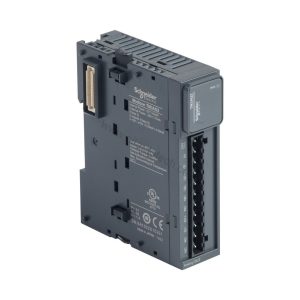
Every unplanned stop on a production line carries a price tag, and analog signal faults rank among the most expensive because they hide inside processes rather than stopping them outright. A drifting 4-20 mA loop can ruin a batch before anyone notices, forcing rework, scrap, and emergency service calls. The Schneider TM3AQ2 analog output module attacks that cost directly by giving Modicon M221, M241, M251, and M262 controllers two software-configurable output channels with 12-bit resolution and ±0.1% of full scale accuracy at 25 °C.
For maintenance managers, the math is simple: fewer failed loops mean fewer line stoppages, and fewer stoppages mean lower cost per produced unit. Because the TM3AQ2 is an active Modicon TM3 expansion module, buyers also avoid the capital expense of replacing an entire controller platform just to gain analog capability.
What the TM3AQ2 Delivers for the Money
The TM3AQ2 is a two-channel analog output module from Schneider Electric’s Modicon TM3 series. Each channel independently supports 0-10 Vdc, ±10 Vdc, 0-20 mA, or 4-20 mA, selected in software rather than by rewiring. That flexibility alone reduces engineering hours, because one stocked module covers voltage and current duties across multiple machines instead of forcing separate part numbers onto the shelf.
Diagnostics for module status and bus status let technicians identify faults without probing every terminal, shortening troubleshooting time and cutting the labor cost attached to each repair. The removable screw terminal block with 5.08 mm pitch further speeds field replacement, since a failed unit can be swapped without disturbing existing wiring runs.
Key Specifications and Their Cost Implications
Accuracy of ±0.1% of full scale at 25 °C, with ±1% of full scale over temperature, keeps process variables tight enough to reduce giveaway and rejected product. In practice, tighter control means less raw material wasted per batch, which compounds into measurable annual savings on high-volume lines.

Isolation of 1500 V AC between output and supply, plus 500 V AC between output and internal logic, protects the controller from field transients. That protection lowers the risk of a single fault destroying a PLC rack, converting a potentially four-figure replacement cost into a simple module swap.
Response time is equally relevant to throughput. Conversion takes 1 ms plus 1 ms per channel plus one controller cycle time, with 1 ms stabilization. For most motion and process loops this is fast enough to avoid slowing the machine, so production rates stay intact after the upgrade.
Specifications at a Glance
| Parameter | Value |
|---|---|
| Channels | 2 analog outputs |
| Signal types | 0-10 V, ±10 V, 0-20 mA, 4-20 mA |
| Resolution | 12 bits |
| Accuracy | ±0.1% FS at 25 °C; ±1% FS over temperature |
| Isolation | 1500 V AC output/supply; 500 V AC output/logic |
| Supply voltage | 24 Vdc via TM3 bus |
| Operating temperature | 0…+55 °C |
| Protection rating | IP20 |
| Dimensions (H×W×D) | 90 × 23.6 × 70 mm |
| Weight | 0.115 kg |
Where the TM3AQ2 Pays for Itself
In a typical packaging line application, a machine builder might use one TM3AQ2 channel to command a proportional valve on a film tensioner and the second to drive an analog speed reference for a conveyor drive. Because both channels are configurable in software, the same module serves either duty, so the builder stocks one spare instead of two and reduces inventory carrying cost.
Water and wastewater plants offer another clear return. A 4-20 mA channel can trim a chemical dosing pump, while the second channel logs a flow signal to the controller. Accurate dosing prevents overuse of treatment chemicals, and chemical spend is often one of the largest variable costs at such sites.
In a typical automotive assembly line application, a realistic illustration rather than a specific customer claim, a TM3AQ2 could regulate a pneumatic clamp pressure through a voltage signal while a second channel reports position feedback to the M241 controller. The 1500 V AC isolation helps shield the PLC from welding equipment transients nearby, protecting the controller investment.

Integration, Compatibility, and Downtime Reduction
The TM3AQ2 mounts as part of the Modicon TM3 expansion family and communicates through the TM3 bus, drawing 24 Vdc from that bus. Bus current is modest: 35 mA at 5 V DC with no load and 40 mA at 5 V DC at full load, plus 30 mA at 24 V DC no load and 70 mA at 24 V DC full load. Low current draw means existing power budgets usually absorb the module without a supply upgrade, avoiding another capital line item.
Compatibility with Modicon M221, M241, M251, and M262 platforms matters commercially because it lets plants standardize on one analog module across mixed controller fleets. Standardization reduces training time, simplifies spare-parts stocking, and shortens the mean time to repair when a channel fails.
Frequently Asked Questions
How many analog outputs does the TM3AQ2 provide?
The module provides two analog output channels, each configurable independently for voltage or current operation.
Which signal ranges can I configure per channel?
Each channel supports 0-10 Vdc, ±10 Vdc, 0-20 mA, and 4-20 mA, selected through software configuration.
Which Schneider controllers work with the TM3AQ2?
It is compatible with the Modicon M221, M241, M251, and M262 platforms as a TM3 expansion module.
What accuracy can I expect over temperature?
Accuracy is ±0.1% of full scale at 25 °C and ±1% of full scale over the operating temperature range.
Is the TM3AQ2 still an active product?
Yes, the lifecycle status is active, last verified in 2026-09, so long-term spare availability is supported.
Buying the TM3AQ2 with Confidence
Oil AutoTech specializes in industrial automation spare parts and news, and we help buyers match the TM3AQ2 to the right Modicon platform before purchase. Our team verifies part numbers against your existing rack configuration, which prevents costly wrong-part orders and return shipping. With active lifecycle status confirmed, the TM3AQ2 remains a sound long-term investment for plants seeking reliable analog control without a full platform change.