Why Compact Control Panels Hit a Wall
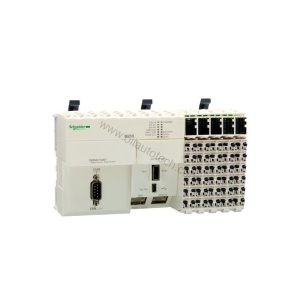
Machine builders constantly face a familiar engineering pain point: control cabinets run out of space before they run out of I/O demand. Adding a larger rack-based PLC forces panel redesign, extra wiring, and longer commissioning time. The Schneider TM258LD42DR Modicon M258 compact logic controller addresses this problem directly by packing 42 I/O, dual-core processing, and embedded communication into a single self-powered unit.
This controller belongs to the Modicon M258 series, a platform Schneider Electric designed for compact machines that still need serious computing power. Instead of accepting a trade-off between footprint and performance, the TM258LD42DR delivers both in one package.
Pain Point One: Slow Scan Times Stall Throughput
High-speed packaging, labeling, and sorting machines live or die by scan time. When a controller cannot process logic fast enough, product changeovers slow down and reject rates climb. The TM258LD42DR answers this with a dual-core ARM Cortex-A8 processor, where Core1 handles program tasks and Core2 manages communication tasks independently.
That architecture produces a scan speed of 0.022 µs per Boolean instruction, translating to more than 45,000 Boolean instructions per millisecond. For machine builders, this means faster response to sensor inputs and tighter coordination between motion, logic, and communication routines.
Pain Point Two: Counting and Positioning Demand Specialized I/O
Standard digital inputs often cannot keep pace with encoder feedback or high-frequency pulse signals. Engineers then add separate counter modules, which increases cost and wiring complexity. The TM258LD42DR integrates 8 high-speed counters rated at 100 kHz directly into the base unit, alongside 26 digital inputs that include 18 regular 24 VDC channels and 8 fast HSC inputs.
On the output side, the controller provides 16 digital outputs split between 4 fast transistor outputs at 0.1 A and 12 relay outputs at 2 A. This mixed relay and transistor design lets one controller drive both high-speed pulse functions and standard inductive loads without extra interface hardware.
Pain Point Three: Fragmented Networks Complicate Integration
Modern production cells rarely run on a single protocol. A controller must speak to drives, HMIs, and plant-level systems simultaneously. The TM258LD42DR includes 1 Ethernet RJ45 port, 1 CANopen SUB-D9 port, 1 RS-485 serial link, and 1 USB-B mini programming port as standard.
Supported protocols cover Modbus TCP over Ethernet, CANopen master, Modbus RTU/ASCII over serial, and a proprietary programming protocol over USB. Two free PCI slots accept optional communication or function modules, while the system supports up to 7 TM5 or TM2 expansion modules for a maximum of 2,400 I/O.
Pain Point Four: Power and Environmental Constraints
Panel space and thermal budgets are always tight. The TM258LD42DR operates on 24 VDC supply within a 19.2 to 28.8 V range and consumes 17.22 W. Because it is a self-powered compact controller, it requires no backplane bus current, simplifying power distribution inside the cabinet.
The unit measures 99 × 265 × 75 mm and weighs 0.5 kg, so it fits into compact enclosures without special mounting hardware. It operates from 0 to +55 °C, with derating allowed up to +60 °C, and tolerates 10 to 95% relative humidity in non-condensing conditions. The IP20 protection rating suits installation inside controlled cabinets.
Pain Point Five: Programming Environments That Slow Development
Engineers lose valuable time when software tools are fragmented across product families. The TM258LD42DR programs through SoMachine or EcoStruxure Machine Expert, giving development teams a consistent environment for logic, configuration, and diagnostics. With 128 K instructions of program memory, 64 MB RAM, and 128 MB Flash, the controller handles substantial application code without external storage.
Business Value: Lower Cost per Controlled Axis
When one compact controller replaces a rack PLC plus separate counter and communication modules, the savings compound across hardware, wiring, panel space, and engineering hours. The TM258LD42DR reduces component count while expanding capability, which directly lowers cost per controlled axis for OEMs building repeat machines.
Downtime also carries a cost. Reliable relay outputs at 2 A and fast transistor outputs at 0.1 A mean fewer external interface failures. Combined with the active lifecycle status of this Modicon M258 model, buyers gain a platform with ongoing availability rather than a dead-end design.
Frequently Asked Questions
What I/O count does the TM258LD42DR provide?
The controller offers 26 digital inputs and 16 digital outputs, totaling 42 I/O. It includes 8 high-speed counters at 100 kHz and 4 fast reflex pulse outputs, with no analog inputs or outputs on the base unit.
Can the TM258LD42DR expand beyond its built-in I/O?
Yes. It supports up to 7 TM5 or TM2 expansion modules, reaching a maximum of 2,400 I/O. Two free PCI slots also accept optional communication or function modules.
Which communication protocols does this controller support?
Built-in protocols include Modbus TCP over Ethernet, CANopen master, Modbus RTU/ASCII over serial, and a proprietary programming protocol over USB. Physical ports include Ethernet RJ45, CANopen SUB-D9, RS-485, and USB-B mini.
What software programs the TM258LD42DR?
Engineers use SoMachine or EcoStruxure Machine Expert. The controller provides 128 K instructions of program memory, 64 MB RAM, and 128 MB Flash for application storage.
Is the TM258LD42DR still an active product?
Yes. The lifecycle status is active, last verified in September 2026. Oil AutoTech supplies this model with quality assurance and stocked availability for automation projects.
Outlook: Compact Controllers Keep Gaining Ground
As machine builders push for smaller panels and faster commissioning, compact controllers with embedded communication will keep displacing larger rack systems. The TM258LD42DR fits that trajectory with dual-core processing, integrated high-speed I/O, and flexible expansion. For teams planning new cells or upgrading legacy panels, this Modicon M258 model offers a practical path to higher throughput at lower system cost.