
When a Legacy I/O Block Stalls Your Ethernet Line
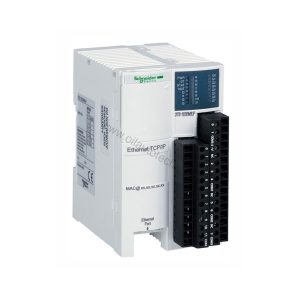
An integrator running a packaging cell recently faced a familiar problem: the machine’s distributed I/O block had failed, and the line could not restart until a compatible replacement arrived. The original block sat on an Ethernet network, handled a mix of digital inputs and relay outputs, and had to fit a tight panel space. That scenario is exactly where the OTB1E0DM9LP from Schneider Electric earns its place in the conversation.
This module belongs to the Advantys OTB series, a family of distributed I/O blocks built for field-level connectivity. It is not a programmable controller; it acts as a bus coupler and distributed I/O slave. For maintenance teams and system integrators, understanding its role, its limits, and its replacement path matters more than ever.
What the OTB1E0DM9LP Actually Delivers
The OTB1E0DM9LP packs 20 I/O points into a compact block measuring 90 × 55 × 70 mm and weighing just 0.195 kg. Twelve of those points are digital inputs rated 24 Vdc with sink/source wiring and Type 1 characteristics per IEC 61131-2. The remaining eight are digital outputs, split between two solid-state PNP outputs at 0.3 A and six relay outputs at 2 A.
Beyond simple discrete I/O, the module includes two high-speed counters at 20 kHz and two pulse generators at 7 kHz. That combination lets it handle counting and basic pulse tasks without adding separate specialty modules. It also accepts up to seven TM2 expansion modules, so a single block can grow with the application.
Key Specifications at a Glance
| Parameter | Value |
|---|---|
| Digital inputs | 12 (24 Vdc, sink/source, Type 1 per IEC 61131-2) |
| Digital outputs | 8 (2 solid-state PNP 0.3 A + 6 relay 2 A) |
| High-speed counters | 2 × 20 kHz |
| Pulse outputs | 2 × 7 kHz |
| Expansion modules | Up to 7 TM2 modules |
| Ethernet port | 1× RJ45, 10/100 Mbit/s |
| Protocols | Modbus TCP, Ethernet TCP/IP, web server, Transparent Ready Class A10 |
| Supply voltage | 24 V DC (20.4…26.4 V) |
| Power consumption | 19 W |
| Operating temperature | 0…+55 °C |
| Protection rating | IP20 |
Where This Module Fits on the Plant Floor
Distributed I/O blocks like the OTB1E0DM9LP typically sit close to sensors and actuators, reducing wiring runs back to a central cabinet. In a typical conveyor application, the 12 digital inputs could read photo-eye and proximity sensor states while the relay outputs drive motor starters or indicator lamps. The two high-speed counters would then track encoder pulses for speed or position feedback.

In a typical packaging line application, the same block might manage product detection, reject gate actuation, and pulse output for a small stepper drive. Because the module supports Modbus TCP and Ethernet TCP/IP over its RJ45 port, it can report status to a supervisory system without a separate gateway. These examples are realistic illustrations, not claims about specific installed sites.
Lifecycle Status and the Upgrade Path
Schneider Electric lists the OTB1E0DM9LP as discontinued, with a stated replacement path of TM3BCEIP plus TM3 distributed I/O. That status does not make the module useless; many lines still run it daily. However, it does change how buyers should plan. Maintenance teams that keep spares on the shelf avoid unplanned downtime, while project teams designing new systems should evaluate the TM3 route.
The lifecycle note also carries a last-verified date of 2026-09, which gives planners a reference point for when the status was confirmed. For existing installations, the practical question is whether to repair, replace like-for-like, or migrate. Each option has a different cost and risk profile.
Business Value: Downtime, Spares, and Migration Timing
For a plant running an Advantys OTB network, the biggest financial exposure is unplanned downtime. A failed I/O block can stop an entire cell, and lead times on discontinued parts can stretch. Holding a verified spare of the OTB1E0DM9LP converts a potential multi-day outage into a short maintenance window.
At the same time, the 19 W power consumption and 24 V DC supply keep the electrical footprint modest, which matters when a cabinet is already near its thermal limit. The IP20 rating means the module belongs inside a protected enclosure, so panel design and cooling remain part of the reliability equation.

Compatibility and Integration Notes
The OTB1E0DM9LP communicates over Modbus TCP and Ethernet TCP/IP, and this network interface module variant also supports EtherNet/IP. It includes a web server and Transparent Ready Class A10 capability, which can simplify commissioning and diagnostics. Communication expansion is defined by the NIM variant, and this specific NIM does not offer further comms expansion.
Because the block accepts up to seven TM2 expansion modules, integrators can add I/O without changing the network architecture. That flexibility helps when a machine is upgraded incrementally rather than replaced outright.
Frequently Asked Questions
Is the OTB1E0DM9LP still available from Schneider Electric?
No. The data lists this model as discontinued, with a replacement path of TM3BCEIP plus TM3 distributed I/O. Buyers should confirm current availability with Oil AutoTech or refer to official Schneider Electric documentation.
Can the OTB1E0DM9LP run as a standalone controller?
No. It is classified as a bus coupler and distributed I/O slave, not a programmable controller. It depends on a network master to coordinate control logic.
What communication protocols does this module support?
It supports Modbus TCP, Ethernet TCP/IP, a web server, and Transparent Ready Class A10. This NIM variant also covers EtherNet/IP, and no further communication expansion is available on this model.
How many expansion modules can I attach?
The module accepts up to seven TM2 expansion modules, which allows incremental I/O growth without replacing the base block.
Why Source Through Oil AutoTech
Oil AutoTech specializes in industrial automation spare parts and keeps hard-to-find modules like the OTB1E0DM9LP on the radar for maintenance teams. The platform pairs product data with practical guidance, so buyers can verify specifications before committing. For discontinued models, that combination of stock awareness and technical clarity shortens the path from failure to fix.
Outlook: Plan Now, Not at Failure
The shift toward Ethernet-based distributed I/O continues across manufacturing, and legacy Advantys OTB installations remain part of that landscape. The OTB1E0DM9LP still serves many lines well, but its discontinued status makes proactive planning essential. Teams that secure spares today and map a TM3 migration path for tomorrow will be the ones who keep production moving.