What Is the 144-202-000-116 CA202 Accelerometer?
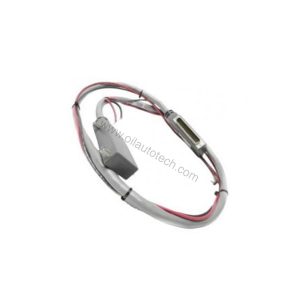
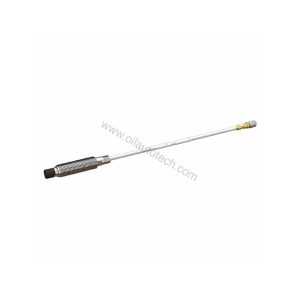
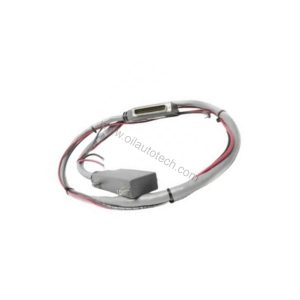
Heavy-duty vibration monitoring in hazardous areas demands a sensor that survives heat, moisture, and mechanical stress. The 144-202-000-116 is the CA202 piezoelectric accelerometer from the Vibro Meter product line, supplied here as the Ex version with a 6 m integral cable. It converts vibration into a charge signal for use with a charge converter signal conditioner, and it needs no input power at the sensor itself.
This buyer’s guide walks through the specifications that matter, the environments the CA202 suits, and the checks to make before you order.
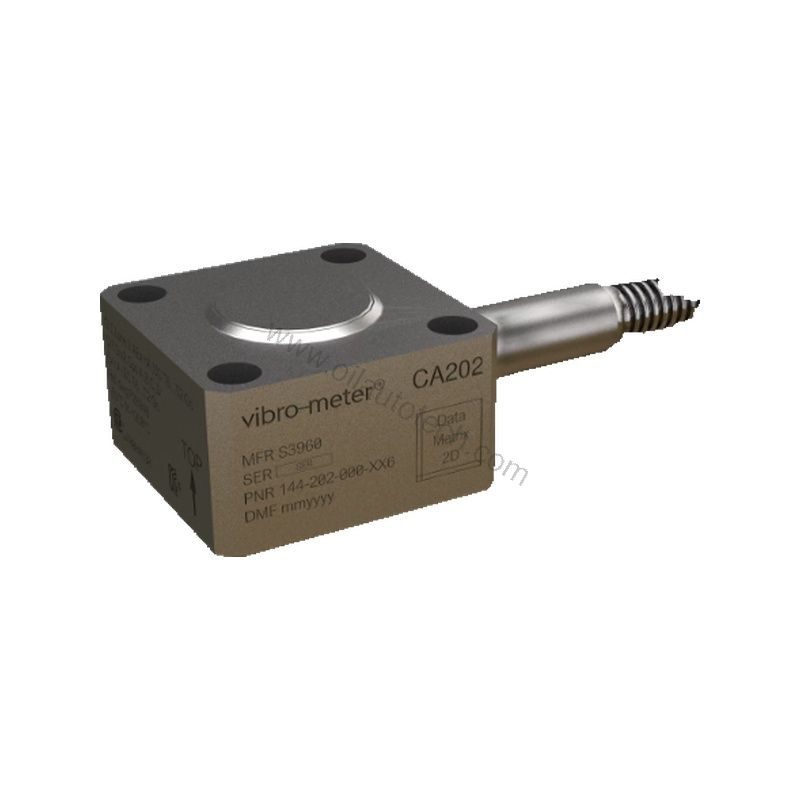
Key Specifications That Drive Performance
Sensitivity and Measurement Range
At 120 Hz with 5 g, the CA202 delivers 100 pC/g ±5%. That high charge output gives a strong signal for long cable runs. The dynamic measurement range spans 0.01 to 400 g peak, with overload capacity up to 500 g peak for spikes. Linearity holds at ±1% from 0.01 to 20 g peak and ±2% from 20 to 400 g peak.
Frequency Response
The frequency response covers 0.5 to 6000 Hz at ±5%, with a typical deviation of +10% at 8 kHz. The lower cutoff frequency is set by the signal conditioner you pair with the sensor, so selection of that unit matters.
Temperature and Environmental Durability
The sensor operates continuously from −55 to +260°C, and the integral cable from −55 to +200°C. Short-term survival reaches −70 to +280°C for the sensor. The austenitic stainless-steel case and heat-resistant stainless-steel protection hose are hermetically welded into a sealed assembly, impervious to humidity, water, steam, oil, and sea-salt atmospheres.
Physical and Mounting Data
The sensor weighs approximately 250 g, and the cable adds 135 g/m. Mounting uses four M6 × 35 Allen screws and four M4 spring-lock washers at a nominal tightening torque of 15 Nm. The unit terminates with flying leads.
Where the CA202 Fits
Industrial vibration monitoring on pumps, compressors, and turbines benefits from the wide 0.5 to 6000 Hz range and the 400 g peak measurement span. In hazardous areas, the Ex version supports installation in potentially explosive atmospheres. Harsh industrial environments with steam, salt, or dust suit the hermetically welded stainless-steel construction. For replacement and upgrade projects, the 144-202-000-116 drops into existing charge-based measurement chains when paired with a compatible charge converter.
Integration and Selection Notes
The CA202 uses a 2-pin system insulated from case with charge output, so it requires a charge converter such as the IPC70x signal conditioner. It has no input power requirement at the sensor. Before ordering, confirm your signal conditioner matches the charge output and that your mounting surface accepts the M6 screw pattern. If you need spares when you need them, Oil AutoTech offers hands-on technical selection help and fast dispatch, worldwide.
Please verify current lifecycle status and availability with Oil AutoTech before ordering.
FAQ
What signal conditioner does the CA202 need?
It requires a charge converter, such as the IPC70x signal conditioner, because the sensor outputs a charge signal with no input power at the sensor.
What is the operating temperature range?
The sensor runs continuously from −55 to +260°C, and the integral cable from −55 to +200°C.
Is this unit rated for hazardous areas?
Yes. The 144-202-000-116 is the Ex version with a 6 m integral cable, intended for installation in potentially explosive atmospheres.
How is the sensor mounted?
It mounts with four M6 × 35 Allen screws and four M4 spring-lock washers at a nominal tightening torque of 15 Nm.
What is the sensitivity of the CA202?
Sensitivity is 100 pC/g ±5% at 120 Hz with 5 g.