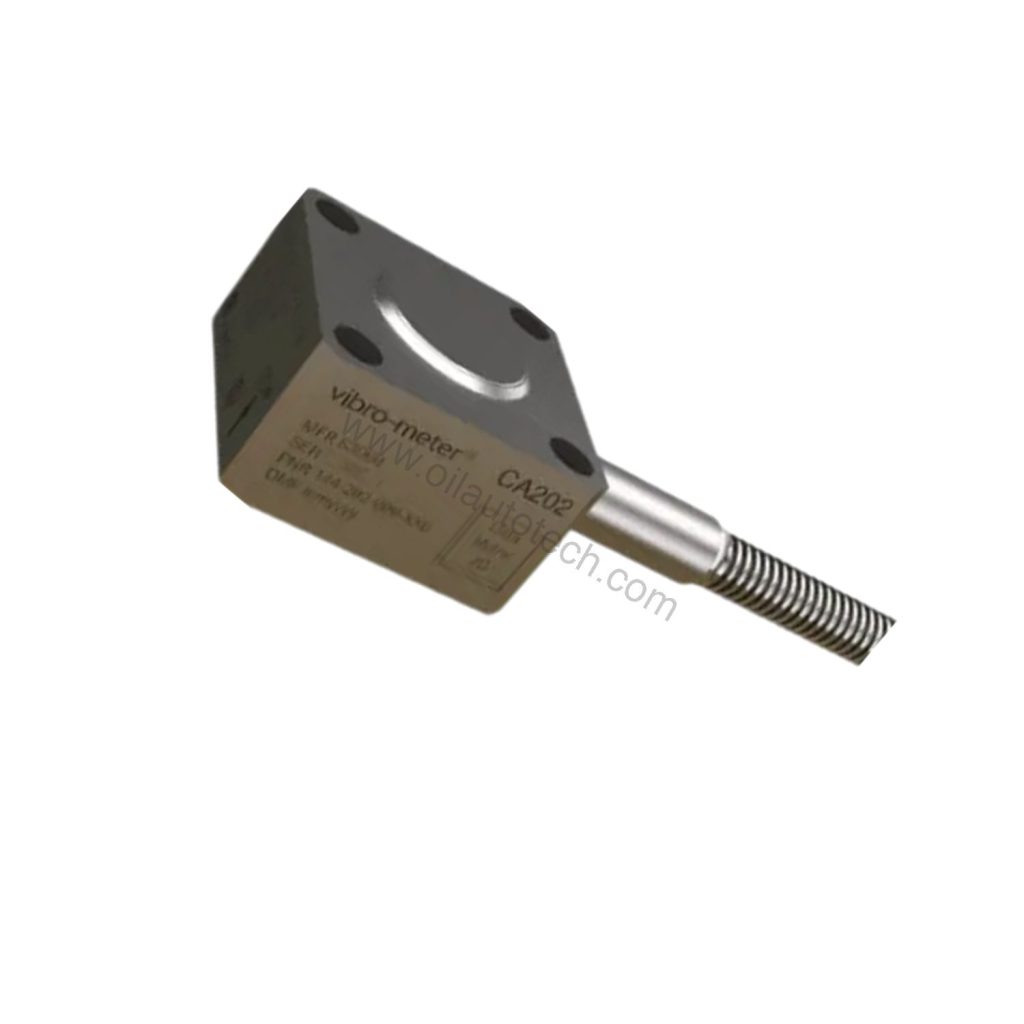
Why the CA202 Belongs in Your Monitoring Loop
When a critical machine train loses its vibration signal, you lose more than data — you lose the ability to see a bearing degrade before it fails. The Vibro Meter CA202 piezoelectric accelerometer, part number 144-202-000-203, is built for exactly that duty: continuous, heavy-duty industrial vibration monitoring where the environment is hot, wet, and unforgiving.
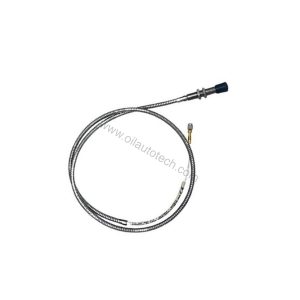
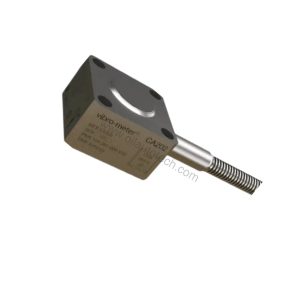
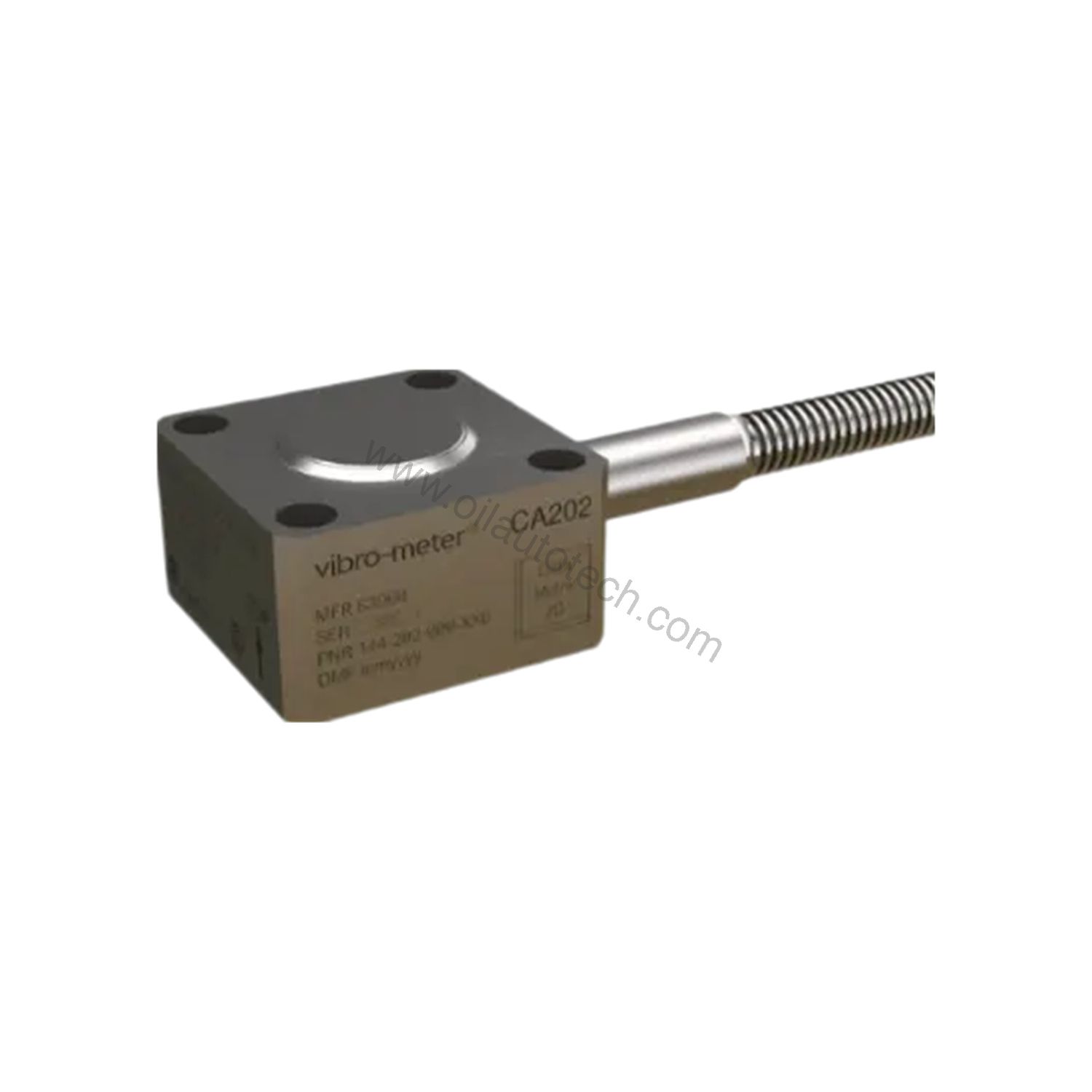
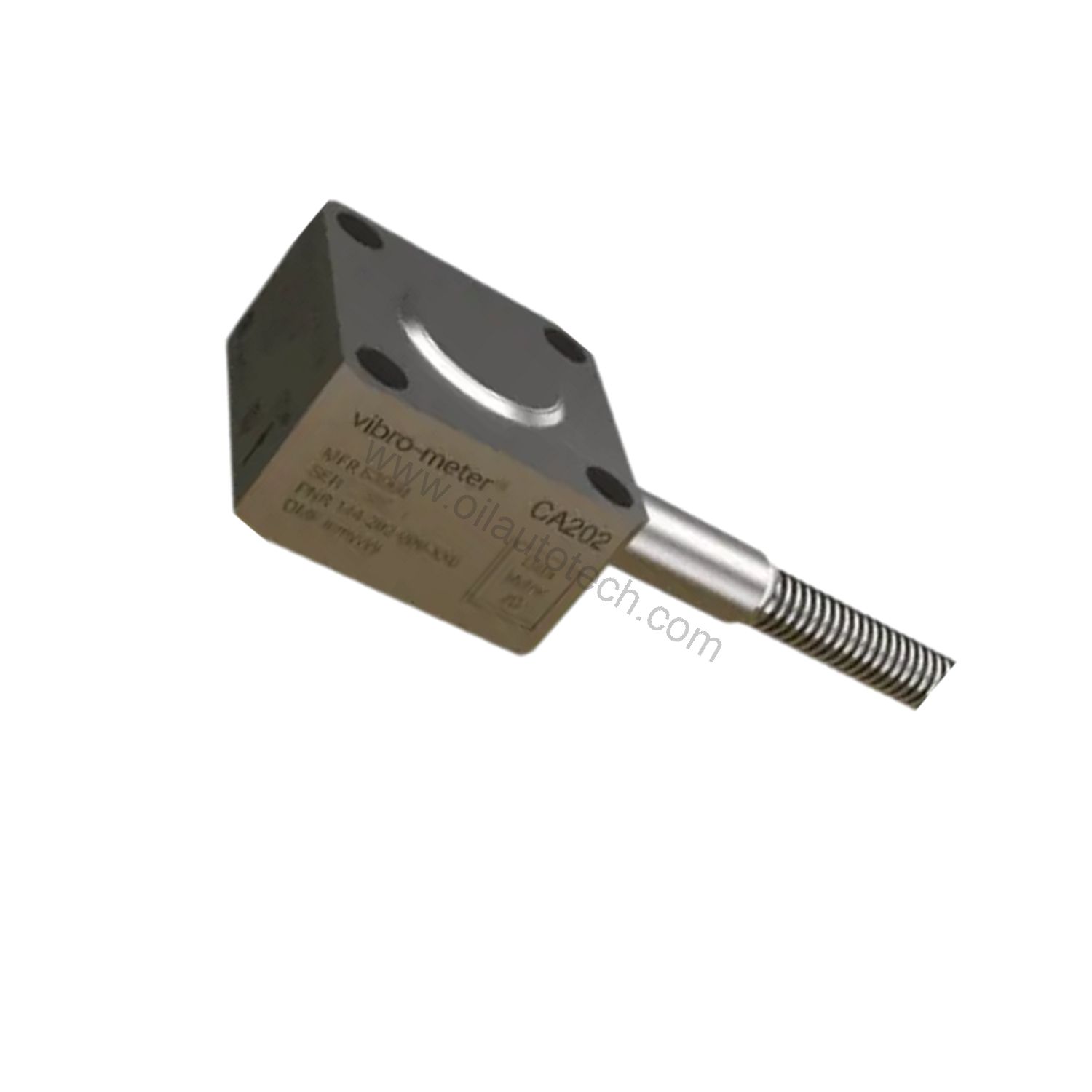
This is a charge-output sensor from Meggitt’s vibro-meter product line. It carries a symmetrical shear-mode polycrystalline measuring element with internal case insulation, housed in a hermetically welded austenitic stainless-steel case. An integral low-noise cable is protected by a flexible stainless-steel hose, welded to the sensor to form a sealed, leaktight assembly.
Key Parameters That Decide the Application
Sensitivity and Range
At 100 pC/g ±5%, the CA202 delivers a strong charge signal that suits long cable runs and charge-converter front ends. The dynamic measurement range spans 0.01 to 400 g peak, with overload capacity to 500 g peak for spikes. Linearity stays within ±1% from 0.01 to 20 g and ±2% from 20 to 400 g.
Frequency Response
The 0.5 to 6000 Hz response holds ±5%, covering the rotating speeds and structural resonances found on pumps, compressors, and turbines. Note that the lower cutoff frequency is set by the signal conditioner, not the sensor alone.
Thermal Envelope
The sensor operates continuously from −55 to +260°C. The integral cable is rated −55 to +200°C. Short-term survival extends to −70 to +280°C for the sensor. Temperature sensitivity error is 0.25%/°C from −55 to +23°C and 0.1%/°C from +23 to 260°C.
Sealing and Materials
The austenitic stainless-steel body and heat-resistant stainless-steel protection hose are hermetically welded together. The assembly resists 100% relative humidity, water, steam, oil, and sea-salt atmospheres, plus dust, fungus, and sand.
Where This Sensor Earns Its Place
Steam turbine and compressor monitoring. The 260°C continuous rating and leaktight stainless construction let you mount the CA202 close to hot casings where ordinary accelerometers degrade.
Hazardous-area installations. The CA202 is available in standard versions and Ex versions certified for use in potentially explosive atmospheres. Confirm the exact version you need with your supplier before ordering.
Marine and offshore machinery. Sea-salt and humidity resistance makes this a practical choice for deck machinery and process equipment in coastal plants.
Integration and Selection Notes
The CA202 uses a 2-pin system, insulated from case, with charge output. It requires no input power. Signal processing comes from a charge converter — for example, an IPC70x signal conditioner. Because the output is charge, not voltage, the cable and conditioner choice directly affects your usable low-frequency limit.
Mounting uses four M6 × 35 Allen screws and four M4 spring-lock washers at a nominal tightening torque of 15 Nm (11.1 lb-ft). The sensor weighs approximately 250 g, and the cable adds roughly 135 g/m. The unit terminates with flying leads.
Before you commit, verify the version (standard or Ex), confirm your signal conditioner matches the charge output, and check that your mounting surface accepts the M6 hardware. The 144-202-000-203 is a specific configuration — do not assume options from other CA202 variants apply.
Please verify current lifecycle status and availability with Oil AutoTech before ordering. Oil AutoTech supplies ready-to-ship industrial automation spares and offers hands-on technical selection help for oil, gas, and industrial monitoring applications. Contact Oil AutoTech today for pricing and availability.